Early in my career, in an interview for a QA role, someone told me people don’t like fluff. Just tell them what they need to know. I got the job. I also walked out with a rule I’ve followed ever since.
Most testers didn’t get that same warning, and it shows in how they write bug reports. It’s worst on the scenarios with more than one moving part. Browsers, environments, build versions, devices, a bug that only shows up on some combination of them.
The novel-length bug report
A bug report already has structure: steps to reproduce, expected result, actual result. That’s not the problem. The problem is what happens once the scenario has more than one variable. Instead of laying the combinations out, people just write it all out in sentences. Something like: it worked as expected on Chrome, but on Safari the button didn’t respond, same thing on staging, but on production it only failed on iOS build 4.2 and not 4.1. That’s one sentence trying to hold four variables and two different outcomes at once.
Nobody parses that on a skim. Devs read it twice looking for the repro steps. PMs read it twice looking for whether it’s a blocker. Stakeholders give up halfway through and ask someone to just explain it out loud. Everyone is extracting the same three or four data points out of a paragraph that was never built to be extracted from.
The wall of text is a trust problem
Formatting changes whether people can check your work. When a report takes five minutes to parse and the reader has thirty seconds, they fall back on your summary line. The evidence may be in the report, but nobody verifies it.
What I switched to
Most of my reporting now goes into a test matrix instead of a narrative. Rows for scenarios, columns for pass, fail, and blocked, one line per result.
Fail is an ❌. Pass is a ✅.
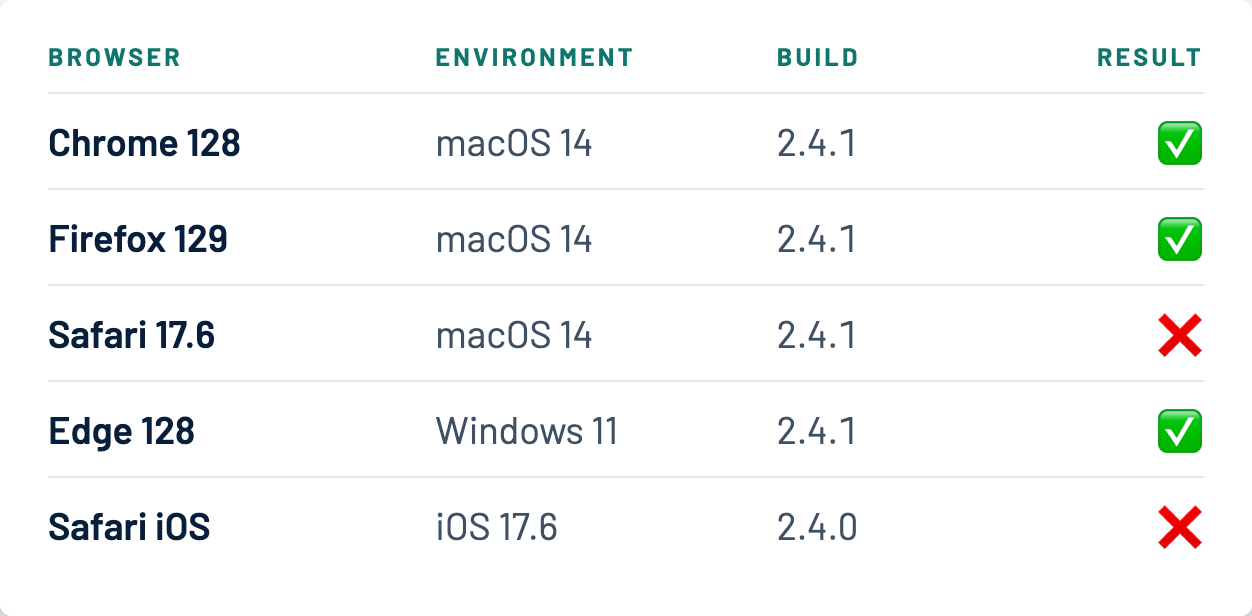
If something needs more context than that, it goes right next to the mark, or into a notes column, not a paragraph. For the multi-variable cases, the browser, environment, build, and device combinations, each one just becomes another column. That sentence that used to try to hold four variables and two outcomes at once becomes a row anyone can scan in a couple seconds. Same coverage, same information, a fraction of the reading. Someone can look at a matrix for a whole feature and know in five seconds where the risk is. The same feature written as a series of bug reports would take five minutes, and most people won’t give it those five minutes.
A complicated bug may still need a careful writeup, especially when reproduction depends on earlier steps and a specific data state. Feature coverage usually doesn’t.
Use prose when the sequence matters. Use a matrix when readers need to compare results. Both make your evidence easier to check when you say exactly what happened.
Comments
Loading comments…
Leave a comment